


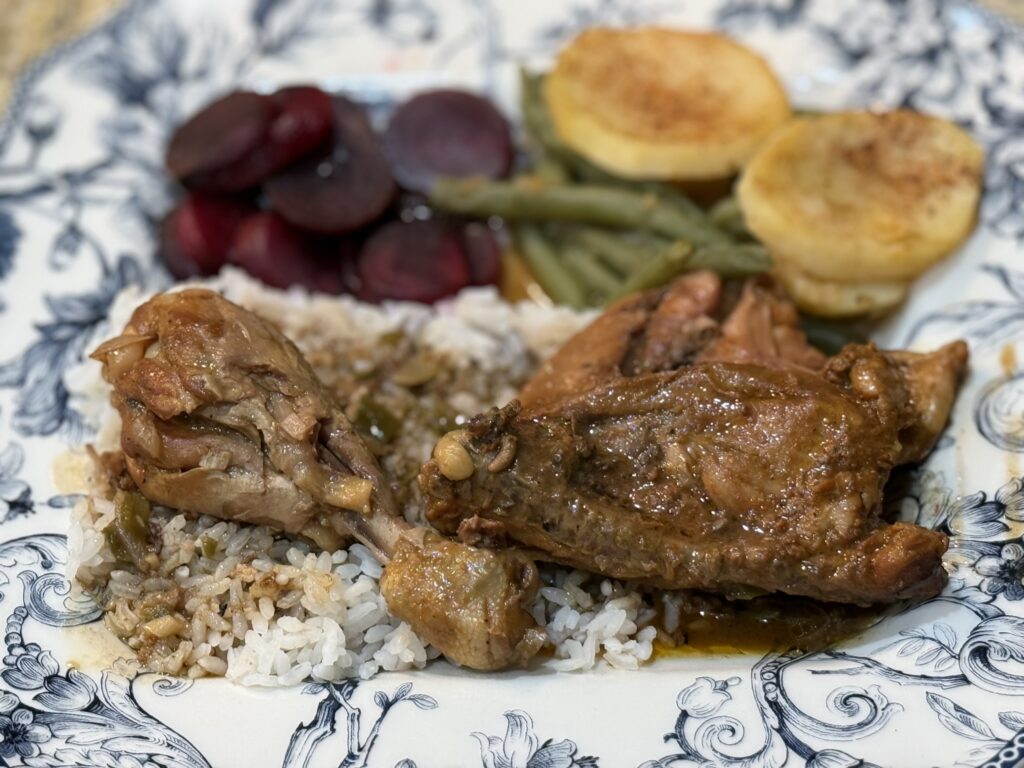
There’s one day in my childhood which I will never forget. It was one of the most anticipated days of my life: the first day of junior high football practice.
I was in seventh grade at Opelousas Catholic Junior High School in Opelousas, Louisiana.
It was a tradition in my home that for supper (which most people call dinner in other parts of the United States), we regularly had a traditional meal called rice and gravy.
And what I mean by regularly was typically a minimum of three times a week.
One night pork.
One night chicken.
One night beef.
Sides were usually sweet peas, black-eyed peas, field peas, corn, or smothered potatoes.
But the main dish was still prepared the same way:
The meat.
The rice.
The thin, brown, rich, and spicy gravy.
Stop right there.
It wasn’t always delicious for this young Cajun boy.
That’s right. While the rest of the family—my two older brothers, my mom, and dad, who was usually the one who prepared these meals—slurped down this amazing dish whose recipe had been passed down through generations, I could not bear the thought of eating a full plate of rice and gravy.
That’s right, I used to eat rice with liquid butter poured from a bright yellow container on top of it while everyone else enjoyed the gravy.
Until that day.
I’ll never forget jumping into my Dad’s blue and white Ford pickup truck, exhausted and dirty, and telling him on the way home, “I’m so hungry right now, tonight I’m gonna eat rice and gravy.”
When we returned home, I don’t even remember if there was a question, because we ate rice and gravy so much for supper that my mom was already home cooking as my Dad was picking me up directly from work.
Anyway, I remember that night eating rice and gravy and never looking back.
Fast forward to 19 years old, living in my first apartment with my two roommates, one who is now an ultra-succsessful ultra-runner, chef, and restaurant owner in Austin, Texas, who also went to the same high school.
We wanted to cook something for dinner. We didn’t know how, so we called my Dad and asked him, “How do you make rice and gravy?”
We were literally craving the dish.
You couldn’t just go out and get rice and gravy at dinnertime in Lafayette, although there were plenty of places where you could get plate lunches, as they were called, only 30 miles away.
Getting a plate lunch at that time just wasn’t possible.
Fast forward two decades.
On my second cross-country road trip, I traveled across the United States as The Cajun Traveler. I approached the area known as Acadia.
For so long, I had dreamed of pulling into multiple plate lunch places along the side of the road to try rice and gravy from the motherland.
Was it even going to be good?
Was it going to be spicy?
Maybe they used lobster instead of crawfish in their étouffée.
RECORD SCRATCH.
This never happened.
Which brought up the question: how can that be?
It never happened because I was warned well ahead of time by my dad that my ancestors in the motherland never ate rice and gravy. You see my father, Charles Dore’ is the son of Olympe Rivette, my grandmother who taught him how to cook rice and gravy. Olympe was the daughter of…ok, let’s stop right there. This is for another post…
Fast forward approximately five years later.
At a surfing hostel in the Dominican Republic, every evening there was a tradition. Some of the ladies who helped run the hostel would cook dinner for everyone staying there.
I don’t remember what they called the dish, but when they served it, I was in shock.
It looked like it.
It smelled like it.
Most importantly, it tasted exactly like my Dad’s smothered chicken.
Even though the sides were different—I believe it was plantains and maybe some other type of peas, I don’t recall—the rice and gravy was exactly the same.
The question about where rice and gravy came from never really came up in my mind again until one day I picked up a book about the story of the Cajun people who were exiled from Canada.
I bought the book as a coffee table reader for my mini Airbnb hostel, affectionately known as Cajun Hostel, which is where I also resided for 25 years of my life (which eventually evolved into the property management company, Cajun Stays).
I remember reading in one part of the book that many of the Acadians who ended up in South Louisiana first landed in Haiti, not far from the Dominican Republic.
Could this have been the missing link?
I never expected to eat rice and gravy anywhere north of the Acadiana area, but certainly larger cities like Baton Rouge and New Orleans would have at least a couple of plate lunch places that actually served brown gravy over rice with either chicken, pork, or beef.
That assumption would be wrong.
The same could be said, up until the past ten years or so, about classic crawfish dishes that are talked about all the time, like boudin, cracklin, and boiled crawfish.
You see, one of the most famous rice and gravy dishes, and one of my dad’s utmost specialties, is crawfish étouffée.
The question came up many times at our family dinners, which still today I get extremely excited about when my parents tell me—after I ask what we’re having for supper—and they respond:
Rice and gravy.
But still, to this day, my dad and I ponder the question:
Why can’t you eat rice and gravy for supper at a restaurant?
There are plenty of rice and gravy plate lunch spots all around Acadiana, spread out over an area of about 50 miles or so.
Once you leave those parishes, even in 2026, the tradition—the accessibility—comes to a screeching halt.
I was bussing tables and waiting tables at the original Prejean’s Restaurant in Carencro, which helped put me through undergraduate school at UL Lafayette while living with those same two roommates.
I’ve always wanted to have some part in a restaurant of my own.
Who knows?
There are several amazing plate lunch shops throughout South Louisiana, especially in the Lafayette area, that serve amazing rice and gravy, but none that look, smell, and taste like the one prepared in my parents’ home.
One that stands out has a connection with me because I often wear a T-shirt that makes it difficult to walk a hundred feet without someone commenting on it. Most people don’t realize that the back says Laura’s II, but the front, in large white letters, simply says:
Raised on Rice and Gravy.
I’ve always had the dream of being nomadic and also becoming a full minimalist, which to me means owning nothing but a backpack and the toiletries I take with me on one of my long international extended solo backpacking trips with no plans, a.k.a. The Cajun Traveler.
One day I got a Facebook Marketplace message from a gentleman who was interested in purchasing a Festival Acadiens poster autographed by the famous local artist Robert Dafford.
When he showed up to my storage unit to pick up the poster, he explained to me that he was one of the owners.
I was wearing, as I do at least once a week, the Raised on Rice and Gravy T-shirt, and he mentioned that the painting was going into his new restaurant called Gravy.
A small part of me inside cringed, wondering:
Is this going to be the first rice and gravy restaurant that serves rice and gravy for supper?
I had heard about the restaurant because it was in the same building, with the same owners, as one of my favorite Lafayette restaurants of all time, Pamplona, and longtime locals’ lunch spot Pat’s, which shared the building, was closing down.
A few weeks later, while driving around downtown Lafayette, where I no longer reside because I am nomadic, I swung by the restaurant.
Not only was I proud to see my paintings already hanging on the walls inside, I also noticed that the restaurant was not open, as it was around five o’clock.
The sign read:
Open Monday through Friday, 10:30 a.m. to 2:30 p.m. Closed Saturday and Sunday.
 Follow my blog with Bloglovin